
How Irreversible Temperature Indicator Labels Work: A Technical Guide
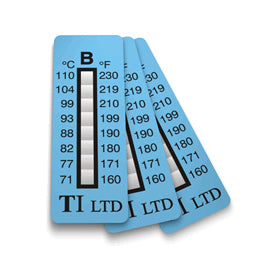

Irreversible temperature indicator labels are one of the most reliable and cost-effective tools available for monitoring thermal exposure in food safety, pharmaceutical distribution, sterilisation validation, and industrial manufacturing. Unlike electronic sensors, they require no power, no calibration at point of use, and deliver an instant, permanent visual record of whether a product or process has been exposed to a critical temperature threshold.
This guide explains the science behind how irreversible temperature indicator labels work, the different types available, and how to select the right indicator for your application.
The Science: How Irreversible Temperature Indicator Labels Work
At the heart of every irreversible temperature indicator label is a deceptively simple mechanism based on the precisely controlled melting behaviour of speciality waxes. Each label contains multiple ultra-thin active layers bonded together in a precise sequence.
The core components are a layer of white crystalline wax, formulated to melt at a specific temperature (accurate to ±1–2°C depending on the product series), a coloured backing layer — typically black, although red and other colours appear in certain ranges — a transparent window layer allowing the colour change to be read clearly, and a pressure-sensitive adhesive backing for attachment to products, packaging, or process equipment.
When the label reaches its rated threshold temperature, the wax melts and is absorbed by capillary action into the porous coloured backing. This reveals the backing colour through the transparent window, producing a permanent, irreversible colour change — most commonly from white to black. The change is permanent because once the crystalline wax structure has collapsed and been absorbed, it cannot reconstitute itself. There is no way to reverse or falsify the reading, which is precisely why these indicators are accepted as evidence in regulatory compliance and HACCP documentation.
Importantly, the indicator responds to actual surface temperature at the point of attachment, not to the ambient air temperature around it. This makes it considerably more reliable than thermocouple averages or data logger summaries for process validation and product monitoring purposes.
Multi-Window Indicators: Mapping Temperature Profiles
Many irreversible temperature indicator labels contain multiple side-by-side windows, each calibrated to a different temperature threshold. These multi-window ascending indicators allow you to reconstruct a partial temperature profile of whatever surface they are attached to.
For example, a five-window indicator calibrated at 60°C, 70°C, 80°C, 90°C, and 100°C will sequentially change colour as each threshold is exceeded. After a sterilisation cycle or retort process, you can quickly determine the maximum temperature reached — not just whether a single threshold was breached, but how far through the temperature range the process reached.
This is particularly valuable in sterilisation validation, where confirming that autoclave or dry heat oven cycles achieved the required temperature throughout the load is a regulatory requirement. It is also essential in retort processing of canned and bottled food, in electronics burn-in testing where hot spots on PCBs must be identified, and in industrial maintenance where bearing, motor, or gearbox temperatures are monitored over operational periods.
Single-Window Threshold Indicators
Where you need to monitor a single critical control point — for example, confirming that a refrigerated product has not exceeded 8°C — a single-window indicator provides a simple, unambiguous pass/fail signal. These are widely used in cold chain monitoring for pharmaceutical and food products, vaccine and blood product distribution where a tamper-evident thermal excursion record is required, and hot surface safety applications where maintenance staff need instant visual confirmation that equipment has reached hazardous temperatures.
Accuracy and Calibration
Quality irreversible temperature indicator labels are manufactured and verified against UKAS-accredited reference standards. The verification process involves attaching the label to a precisely controlled temperature stage — such as a Linkam TP92 or equivalent — raising the temperature at a controlled rate of 2°C per minute, and recording the exact temperature at which colour change begins and completes.
Well-manufactured labels achieve an overall system accuracy of ±1–2°C, which meets the requirements of the vast majority of food safety, pharmaceutical, and industrial applications. For applications requiring tighter control, it is important to specify both the thermal ramp rate and the intended exposure duration at point of order. Activation temperature can be influenced by the rate of heating: a label exposed to a slowly rising temperature will activate at a marginally lower reading than one subjected to a rapid temperature spike.
Applications by Industry
Food Safety and HACCP
In food manufacturing and distribution, irreversible temperature indicator labels verify that heat treatments — pasteurisation, sterilisation, and retort processing — have been completed correctly. They are also applied to chilled and frozen products to provide a permanent record of any cold chain excursion during transit or storage, directly supporting HACCP documentation and traceability requirements under UK food hygiene legislation, EU Regulation 852/2004, and FDA FSMA.
Pharmaceutical and Healthcare
The pharmaceutical sector relies on irreversible indicators to monitor cold chain integrity for temperature-sensitive medicines, vaccines, and biologics. They are central to sterilisation validation in hospital sterile services departments (SSD) and medical device manufacturing, where autoclave cycle monitoring is mandated under ISO 11140-1, ISO 13485, and equivalent national standards.
Industrial and Manufacturing
In manufacturing environments, irreversible indicators monitor bearing and motor temperatures to detect early mechanical failure, verify that powder coating and curing ovens achieve correct temperatures across the full load, and confirm that heat shrink, sealing, and bonding processes reach the required thermal profile. Their low cost and zero maintenance make them ideal for high-volume production monitoring where electronic sensors would be impractical.
Automotive and Motorsport
Irreversible temperature indicators are used extensively in motorsport and automotive development to monitor brake caliper, disc, rotor, and bearing temperatures during testing and competition. Applied before a test session and read afterwards, they provide a cost-effective method of identifying whether thermal limits have been reached, helping engineers make informed decisions about material selection, cooling design, and component ratings.
Selecting the Right Irreversible Temperature Indicator
Choosing the correct indicator involves four key considerations. First, the required temperature range: what threshold or range of thresholds must be detected? Second, the surface type: adhesive performance varies significantly between plastics, metals, glass, and corrugated packaging — specifying the substrate at point of order ensures correct adhesive selection. Third, the exposure duration: is the label monitoring a brief peak temperature during a retort cycle, or continuous long-term temperature exposure over weeks or months? Finally, the environmental conditions: will the label encounter moisture, oils, steam, or cleaning chemicals? Certain indicator types are manufactured with enhanced resistance to specific environmental contaminants.
Temperature Indicators Ltd carries an extensive range of irreversible temperature indicator labels from leading manufacturers, covering thresholds from below 40°C to above 260°C across standard, high-accuracy, and specialist product lines.
Frequently Asked Questions
Can irreversible temperature indicator labels be reset or reversed?
No — by design, they cannot be reset. Once the wax has melted and the colour change has occurred, it is permanent and cannot be reversed or altered. This irreversibility is fundamental to their value in quality assurance and regulatory compliance applications, where a reliable, tamper-evident record of thermal exposure is required.
How long do irreversible temperature indicator labels last before use?
Shelf life varies by product, but most quality irreversible indicators have a shelf life of two to five years when stored correctly at room temperature, away from direct heat, humidity, and sunlight. Always confirm the shelf life and storage conditions from the product data sheet, and rotate stock to ensure indicators are used well within their stated shelf life.
Can they be applied inside sealed packaging?
Yes — irreversible indicators are routinely applied inside sealed packaging to provide a tamper-evident thermal record that travels with the product throughout the supply chain. Certain types are specifically formulated for use in modified atmosphere packaging (MAP) and vacuum-packed environments.
Do they meet food contact requirements?
Many of the irreversible temperature indicator labels we supply are available in food-contact-compliant versions. Please specify your food contact requirements when enquiring so we can confirm the appropriate product and provide the relevant compliance documentation.
What is the difference between an irreversible and a reversible temperature indicator?
An irreversible indicator permanently changes colour when its threshold is reached and does not revert. A reversible indicator — such as a thermochromic liquid crystal strip — changes colour in response to temperature but returns to its original state when the temperature changes. Irreversible indicators are used where a permanent record is needed; reversible indicators are used where real-time temperature reading is required.
About Temperature Indicators Ltd
Temperature Indicators Ltd is a specialist global distributor solely focused on temperature-sensitive labels, tags, and indicators for cold chain monitoring, process validation, and regulatory compliance. With 35 years of experience and operations shipping to over 50 countries worldwide, we supply food manufacturers, pharmaceutical distributors, sterile services departments, and logistics providers with the temperature monitoring solutions they need to maintain compliance. Contact us for expert guidance on temperature monitoring for your application.
Legal Disclaimer
The information provided in this article is for general guidance only. Temperature Indicators Ltd makes no warranties, express or implied, regarding the accuracy or completeness of this content. Product specifications, regulatory requirements, and industry standards may change over time. Always verify current requirements with the relevant regulatory authority and consult a qualified professional before making decisions based on information contained in this article. Temperature Indicators Ltd accepts no liability for actions taken in reliance on information provided here.
- Temperature Indicators Staff


