
Surface Temperature Warning Labels: How the Tempsafe 70 Protects Workers from Burns

Burns from contact with hot surfaces are one of the most common workplace injuries across manufacturing, catering, healthcare, and process industries. Many of these incidents occur not because safety procedures are inadequate, but because equipment surfaces that look ordinary at a glance are dangerously hot — and there is no visible indication of the hazard until it is too late.
The Tempsafe 70 surface temperature warning label addresses this problem directly. It is a self-adhesive label that is invisible as a warning at safe temperatures, but becomes visually prominent the moment the surface it is attached to reaches a potentially dangerous level. This article explains how the Tempsafe 70 works, where it is used, and why surface temperature warning labels are an effective and low-cost component of any hot surface risk management programme.
How the Tempsafe 70 Works
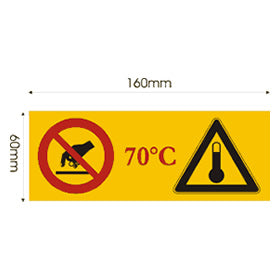
The Tempsafe 70 is an ingeniously straightforward product. The label is printed with a warning image — a bold warning triangle, a temperature figure, and a thermometer graphic — on a high-visibility yellow background. In its normal state, however, this warning image is completely obscured. The label is coated with a layer of thermochromic material that is black at temperatures below its activation point, covering the printed warning beneath and causing the label to appear as a plain black rectangle when applied to a surface.
When the surface temperature rises to 70°C, the thermochromic coating rapidly becomes transparent, revealing the warning image beneath in full colour. The label transforms almost instantaneously from an unremarkable black rectangle to a vivid, high-contrast warning sign — visible from a distance and impossible to ignore.
As the surface cools below 70°C, the thermochromic coating returns to its black state and the warning disappears again. This reversibility means the label functions continuously throughout the life of the equipment it is applied to, providing a live temperature-status indicator with no maintenance, no power, and no manual intervention required.
Why 70°C?
The 70°C activation threshold of the Tempsafe 70 is chosen based on established burn injury research. At surface temperatures above 48°C, skin contact for more than a few seconds can cause scalding burns. At 60°C, a burn can result from contact of less than one second. By 70°C, even momentary contact with a surface presents a serious burn risk.
Many industrial equipment surfaces — steam pipes, heat exchangers, process vessels, industrial ovens, catering equipment, and hydraulic systems — routinely reach or exceed 70°C during normal operation. Workers who handle, inspect, or work near this equipment may not be aware that surfaces are hot, particularly if the equipment has recently been started up, has been running under increased load, or is in an unfamiliar area of the facility.
Positioning the Tempsafe 70 on these surfaces provides an automatic, continuous warning that activates precisely when the hazard is present — without relying on workers to remember where hot surfaces are, or on supervisors to mark out hazard zones manually.
Applications of the Tempsafe 70
Manufacturing and Processing Plants
Process pipework, heat exchangers, steam mains, and reactor vessels in chemical, pharmaceutical, food, and petrochemical facilities regularly reach temperatures well above 70°C. The Tempsafe 70 applied to these surfaces warns maintenance engineers, operators, and contractors before they make accidental contact during routine operations, inspection rounds, or emergency response. It is particularly valuable in areas where PPE compliance is variable, or where contractors unfamiliar with the site may encounter hot surfaces.
Catering and Commercial Kitchens
Commercial kitchen equipment — including combi ovens, deep fat fryers, bain maries, and steam ovens — presents significant burn risk to kitchen staff. The Tempsafe 70 applied to external surfaces of this equipment provides a clear, live warning when surfaces are at dangerous temperatures, complementing existing burn prevention training and reducing reliance on verbal reminders and static warning signs that may be ignored over time.
Healthcare and Sterilisation Environments
Autoclaves, steam sterilisers, and drying ovens in hospital sterile services departments reach operating temperatures far in excess of 70°C. Staff loading and unloading these units can risk burns if they contact the outer casing or door surfaces before the unit has fully cooled. Tempsafe 70 labels provide a continuous, visible reminder of surface temperature status, supplementing procedural controls with a physical warning that does not depend on correct PPE use or procedure memory.
HVAC and Building Services
Heating pipework, boiler casings, and heat pump components in commercial buildings can reach temperatures above 70°C and present a burn risk to maintenance engineers and building users if inadequately guarded. The Tempsafe 70 provides a simple, maintenance-free method of indicating live surface temperature status on any accessible hot surface.
Automotive and Industrial Maintenance
Engine bay components, exhaust manifolds, turbochargers, and hydraulic system components on plant machinery and vehicles reach extreme temperatures during and after operation. Workshop staff working on recently run vehicles or machinery risk serious burns from contact with these surfaces. The Tempsafe 70 applied to high-risk areas provides a permanent, automatic warning that activates whenever the surface is genuinely dangerous — even in workshop environments where equipment may be started and stopped repeatedly throughout the day.
Regulatory Context: Hot Surface Risk Management
Under the UK Health and Safety at Work Act 1974, the Provision and Use of Work Equipment Regulations 1998 (PUWER), and the Control of Substances Hazardous to Health Regulations, employers have a duty to eliminate or control the risk of burns from hot surfaces where reasonably practicable. Risk assessments must identify hot surface hazards, and appropriate controls — including guarding, insulation, PPE, and warning systems — must be implemented.
Surface temperature warning labels like the Tempsafe 70 are recognised as an effective engineering control and a useful supplement to administrative controls such as training and safe systems of work. They are particularly valuable in risk assessments where guarding or insulation is impractical, or where residual hot surface risk remains after primary controls have been applied.
In food processing environments, hot surface risk management is also relevant to food safety, as burns to workers handling food or food-contact equipment can introduce contamination risks. The Tempsafe 70 supports both worker safety and food hygiene objectives in these settings.
Comparing the Tempsafe 70 to Other Hot Surface Warning Solutions
Traditional hot surface warning approaches include static warning signs, painted hazard markings, thermal insulation, and physical guarding. Static signs and markings have the significant disadvantage of being permanently present regardless of whether the surface is actually hot at that moment, which leads to habituation — workers begin to ignore warnings that are always there. The Tempsafe 70 activates only when the hazard is present, making it considerably more effective at capturing attention.
Thermal imaging cameras and electronic surface thermometers provide accurate surface temperature readings, but require manual operation and trained personnel. The Tempsafe 70 requires no operation, no training, and no ongoing maintenance — it simply works continuously for the life of the equipment.
Frequently Asked Questions
Is the Tempsafe 70 a single-use label?
No — the Tempsafe 70 is fully reversible and reusable. The thermochromic coating cycles between black (below 70°C) and transparent (above 70°C) repeatedly throughout the label's service life. No replacement is needed unless the label becomes physically damaged or detaches from the surface.
What surfaces can the Tempsafe 70 be applied to?
The Tempsafe 70 is suitable for application to metal, glass, ceramic, and rigid plastic surfaces. It is not recommended for highly textured, porous, or flexible substrates where full contact between the label and the surface cannot be maintained. For curved surfaces, ensure the label is applied flat and without air bubbles to achieve accurate thermal response.
Are there other activation temperature options available?
Yes — surface temperature warning labels are available in a range of activation thresholds to suit different applications. Contact Temperature Indicators Ltd to discuss the appropriate activation temperature for your specific equipment and risk profile.
How durable is the Tempsafe 70 in industrial environments?
The Tempsafe 70 is manufactured for use in industrial environments and is resistant to normal cleaning, moderate oil contamination, and mechanical abrasion. For environments involving chemical exposure, high-pressure cleaning, or immersion in liquids, a specialist chemical-resistant surface indicator variant may be more appropriate.
Can surface temperature warning labels replace physical guarding?
Surface temperature warning labels are an effective complementary control measure, but they should not replace physical guarding where guarding is reasonably practicable. They are most valuable as a supplementary warning for residual hot surface risk that cannot be fully eliminated by guarding or insulation, and as an additional layer of protection in risk management strategies.
About Temperature Indicators Ltd
Temperature Indicators Ltd is a specialist global distributor solely focused on temperature-sensitive labels, tags, and indicators for cold chain monitoring, process validation, and regulatory compliance. With 35 years of experience and operations shipping to over 50 countries worldwide, we supply food manufacturers, pharmaceutical distributors, sterile services departments, and logistics providers with the temperature monitoring solutions they need to maintain compliance. Contact us for expert guidance on temperature monitoring for your application.
Legal Disclaimer
The information provided in this article is for general guidance only. Temperature Indicators Ltd makes no warranties, express or implied, regarding the accuracy or completeness of this content. Product specifications, regulatory requirements, and industry standards may change over time. Always verify current requirements with the relevant regulatory authority and consult a qualified professional before making decisions based on information contained in this article. Temperature Indicators Ltd accepts no liability for actions taken in reliance on information provided here.
- Temperature Indicators Staff


