
Thermochromic Liquid Crystal (TLC) Temperature Strips: How They Work and Where They're Used
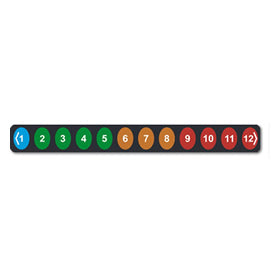

Thermochromic Liquid Crystal (TLC) temperature indicating strips offer a fast, accurate, and easy-to-read method of displaying the actual current temperature of a surface in real time. Unlike irreversible temperature indicators, which record the maximum temperature a surface has reached, TLC strips continuously update their colour display as temperature changes — making them ideal for any application where you need to monitor live temperature conditions without electronic equipment.
This article explains how thermochromic liquid crystal strips work, what they measure, where they are used across industry, and how to select the right strip for your specific application.
How Thermochromic Liquid Crystal Temperature Strips Work
Thermochromic liquid crystals are organic compounds that change their molecular structure in response to temperature. At different temperatures, TLC molecules adopt different orientations, and each orientation reflects a different wavelength of visible light. As a result, the colour of a TLC element changes predictably and continuously across a defined temperature range.
In a TLC temperature indicating strip, microencapsulated liquid crystals are coated onto a black backing substrate. The black background is essential — it absorbs light that is not reflected by the TLC layer, making the colour display vivid and easy to read. The crystals are protected within tiny polymer capsules that are both mechanically robust and chemically inert, allowing the strips to be used in wet, oily, or chemically demanding environments without degradation of the indicating layer.
As the surface temperature of the strip rises through its calibrated range, each temperature-sensing element passes through a sequence of colours: typically from no display (below range) through red, orange, yellow, green, and blue, before transitioning back to an uncoloured state (above range). Reading the strip involves identifying which element is displaying the green or blue colour — the most optically distinctive point in the sequence — and matching it to the corresponding temperature marking on the strip.
When the surface cools, the crystals return to their original orientation and the colour display reverses. This makes TLC strips fully reusable and suitable for continuous monitoring applications over extended periods.
Calibration and Accuracy
TLC temperature indicating strips are calibrated against traceable reference standards, typically achieving an accuracy of ±1°C across their rated temperature range when applied correctly to the target surface. Each element within the strip is individually calibrated, so the strip displays not just a threshold but a graduated, quantitative temperature reading across a defined span — commonly a 4°C or 6°C window, though wider-range strips are available for less precise applications.
Accuracy depends on correct application. The strip must be in full, flat contact with the surface being measured. Air gaps, curved surfaces, or residual adhesives beneath the strip will introduce measurement errors. For maximum accuracy, the strip should be allowed to equilibrate for at least 30 seconds after application before the reading is taken.
TLC Strips vs. Irreversible Temperature Indicators
It is important to understand the functional difference between thermochromic liquid crystal strips and irreversible temperature indicator labels. TLC strips display the current temperature of the surface they are attached to — they are a real-time measurement tool. They do not record maximum temperature exposure, and their colour display reverses when the temperature changes. Irreversible indicators, by contrast, permanently record whether a threshold has been exceeded, providing documentary evidence for regulatory and quality purposes. The two technologies are complementary rather than interchangeable, and many operations use both: TLC strips for real-time process monitoring and irreversible indicators for permanent quality records.
Applications of TLC Temperature Indicating Strips
Food Service and Catering
TLC strips are widely used in food service operations to verify that heated surfaces, hot-holding equipment, and food preparation surfaces have reached or are maintaining the correct temperature. They provide instant, readable confirmation without the need to insert a probe thermometer, reducing cross-contamination risk in high-throughput kitchen environments. They are also used to verify the temperature of chilled surfaces and display counters, confirming that food is being held at safe temperatures.
Healthcare and Patient Safety
In healthcare, TLC strips are used to verify the temperature of warm compress packs, sterilised instrument trays, and patient warming devices. Forehead thermometer strips using TLC technology provide a rapid, non-invasive initial temperature screen for patients, though clinical decisions should always be confirmed with a calibrated electronic thermometer.
Industrial Process Monitoring
Manufacturing and process environments use TLC strips to monitor surface temperatures on heated rollers, sealing bars, laminating equipment, and moulding tools, providing the operator with continuous visual feedback during production. They are also applied to pipe surfaces to monitor the temperature of fluid flows in heating, cooling, and chemical processing systems, and to electrical equipment such as transformer housings and control panel components where elevated surface temperature can indicate developing faults.
Aquariums and Liquid Storage
TLC strips are the de facto standard temperature indicator for glass aquariums, providing hobbyists and commercial fish keepers with a continuous, at-a-glance reading of water temperature. They are also applied to fermentation vessels, storage tanks, and laboratory containers where a quick visual check of liquid temperature is required.
HVAC and Building Services
Building services engineers use TLC strips on ductwork, pipework, and radiator surfaces to verify system performance during commissioning and fault-finding. They provide a useful supplement to thermocouple and data logger measurements, offering instant visual confirmation at any point in the system.
Selecting the Right TLC Temperature Strip
The most important selection parameter for a TLC strip is the temperature range you need to display. TLC strips are available in a wide variety of calibrated ranges, typically spanning 4–6°C per strip, centred on the temperature you need to monitor. For example, a strip calibrated for 35–39°C is suitable for monitoring human body surface temperature; one calibrated for 18–24°C is appropriate for ambient room temperature monitoring; and strips calibrated from 60°C upwards are available for industrial process monitoring.
Consider also the surface type and mounting requirement. Most TLC strips have a self-adhesive backing for permanent attachment to a surface. Reusable strips with no adhesive are available for applications where the strip needs to be moved between surfaces. For irregular or curved surfaces, flexible strip formats may be required to ensure full contact and accurate reading.
Finally, consider the chemical environment. Standard TLC strips perform well in clean, dry conditions. For applications involving moisture, steam, oils, or cleaning chemicals, specify chemical-resistant strip formats to maintain accuracy and legibility over time.
Frequently Asked Questions
Do TLC strips provide a permanent record of temperature?
No — TLC strips display the current temperature only. They are reversible: when the temperature changes, the display changes with it. They do not retain any record of temperatures previously reached. For a permanent record of maximum temperature exposure, an irreversible temperature indicator label is required.
How long do TLC strips last?
When stored correctly and not exposed to prolonged UV light or chemical contamination, TLC strips typically have a shelf life of two to three years and can remain in service on a surface for a similar period. Over time, exposure to UV, oils, or repeated thermal cycling beyond their rated range may degrade the liquid crystal layer and reduce accuracy.
Can TLC strips be used in freezing conditions?
Standard TLC strips are calibrated for use above 0°C. Specialist low-temperature TLC formulations exist for sub-zero monitoring, but standard aquarium and industrial strips should not be used to monitor temperatures below their rated range, as the liquid crystal layer becomes unresponsive and the reading will be unreliable.
Are TLC temperature strips accurate enough for regulatory use?
TLC strips achieve ±1°C accuracy within their rated range, which is sufficient for many monitoring and verification applications. However, for applications where regulatory compliance documentation is required — such as HACCP critical control point records, pharmaceutical cold chain monitoring, or medical device sterilisation — an irreversible indicator label or calibrated electronic data logger is more appropriate, as these provide a permanent, tamper-evident record.
What is the difference between TLC strips and bimetallic thermometer strips?
TLC strips work by the optical properties of liquid crystals changing with temperature. Bimetallic thermometer strips use two bonded metals with different thermal expansion coefficients, causing the strip to bend in response to temperature change. TLC strips are thinner, more accurate at a given point, and easier to read visually, while bimetallic types are more durable in harsh environments. For precision surface temperature monitoring, TLC strips are generally preferred.
About Temperature Indicators Ltd
Temperature Indicators Ltd is a specialist global distributor solely focused on temperature-sensitive labels, tags, and indicators for cold chain monitoring, process validation, and regulatory compliance. With 35 years of experience and operations shipping to over 50 countries worldwide, we supply food manufacturers, pharmaceutical distributors, sterile services departments, and logistics providers with the temperature monitoring solutions they need to maintain compliance. Contact us for expert guidance on temperature monitoring for your application.
Legal Disclaimer
The information provided in this article is for general guidance only. Temperature Indicators Ltd makes no warranties, express or implied, regarding the accuracy or completeness of this content. Product specifications, regulatory requirements, and industry standards may change over time. Always verify current requirements with the relevant regulatory authority and consult a qualified professional before making decisions based on information contained in this article. Temperature Indicators Ltd accepts no liability for actions taken in reliance on information provided here.
- Temperature Indicators Staff


