
Technical Bulletin: Lead-Free, Latex-Free Autoclave Tape for Healthcare Sterilisation
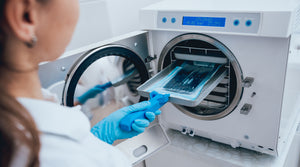

Autoclave tape — also known as sterilisation process indicator tape — is one of the most widely used Class 1 chemical indicators in healthcare sterilisation. Applied to the outside of wrapped instrument sets, cassettes, and pouches before loading into the autoclave, it provides immediate visual confirmation that the package has been processed — and that it should not be mistaken for an unprocessed item on the way to or from the sterile services department. But not all autoclave tapes are the same, and in an era of increasing regulatory scrutiny and heightened awareness of latex allergy and heavy metal toxicity in healthcare environments, the specification of the tape used matters as much as the fact that it is used at all.
This technical bulletin explains what autoclave tape is, how it works, the regulatory requirements governing its use, and why lead-free, latex-free formulations are now the standard for clinical and compliance-conscious healthcare operations.
What Is Autoclave Tape and How Does It Work?
Autoclave tape is a Class 1 chemical indicator under ISO 11140-1, which classifies chemical indicators for sterilisation processes by their intended use and performance requirements. Class 1 indicators are process indicators — they are designed to demonstrate that a package has been subjected to the sterilisation process (i.e., it has been placed in and through the autoclave), not to verify that all sterilisation parameters were achieved throughout the load. This distinction is important: autoclave tape is not a sterilisation validation tool; it is a processing confirmation tool and a safeguard against mix-up of processed and unprocessed items.
The tape works by incorporating a heat-sensitive chemical dye layer that changes colour when exposed to the temperature of an autoclave cycle. In a standard steam autoclave cycle, this typically means exposure to steam at 121°C or 134°C for the required hold time. The dye changes colour in response to this heat exposure, producing a clear visual pattern — typically diagonal stripes or the word "STERILE" or "PROCESSED" — that was not visible before processing. The change is irreversible: the processed pattern remains permanently visible regardless of cooling or handling after the cycle.
Lead-Free Formulations: Why They Matter
Traditional autoclave tape formulations used lead compounds as part of the dye system — a well-established chemistry that produced reliable, stable colour changes at autoclave temperatures. However, lead is a toxic heavy metal with well-documented health risks at low levels of exposure, and its use in products in direct or indirect contact with healthcare environments is increasingly regulated and restricted.
In the European Union, the Restriction of Hazardous Substances (RoHS) Directive restricts the use of lead and other hazardous substances in electrical and electronic equipment. While autoclave tape is not an electrical product, the trend toward elimination of lead from medical and healthcare-adjacent materials has led manufacturers to develop lead-free dye systems that produce equivalent colour change performance without the toxicity concern. In the NHS and private healthcare sector, procurement policies increasingly specify lead-free materials for consumables that may be handled by staff and patients, and CQC (Care Quality Commission) inspection criteria for sterile services have evolved to reflect this expectation.
Lead-free autoclave tape formulations are available that match or exceed the performance of traditional lead-containing formulations, with equivalent colour change characteristics, adhesive performance, and shelf life. For healthcare organisations committed to minimising the use of hazardous substances in the clinical environment, specifying lead-free autoclave tape is a straightforward measure with no compromise in performance.
Latex-Free Formulations: Clinical Necessity
Latex allergy is a significant occupational health issue in healthcare settings, affecting an estimated 8–17% of healthcare workers in some studies, with severe reactions possible in sensitised individuals from even small amounts of airborne latex protein. Medical devices and consumables used in the clinical environment must be latex-free to protect both patients and staff — a requirement that is explicit in NHS procurement policies and reflected in the CE marking and regulatory requirements for medical devices under the EU MDR and the UK's equivalent post-Brexit framework.
Autoclave tape that contains latex in its adhesive formulation presents a potential allergen exposure risk, particularly during the handling of wrapped instrument sets in sterile services departments and operating theatres where staff are already managing multiple latex-free requirements. Specifying latex-free autoclave tape eliminates this risk at the source, with no compromise in adhesive performance or tape handling characteristics.
Temperature Indicators Ltd supplies autoclave tape in lead-free, latex-free formulations for 121°C and 134°C steam sterilisation cycles. Our tape complies with ISO 11140-1 Class 1 requirements and is suitable for use in NHS and private healthcare sterile services departments, dental practices, veterinary facilities, and any other environment where steam sterilisation monitoring is required.
Autoclave Tape in the Sterilisation Quality System
Class 1 process indicators such as autoclave tape form one component of a multilayer sterilisation quality assurance system. They work alongside Class 4, 5, or 6 chemical indicator strips placed inside the instrument set (which verify that sterilisation conditions were achieved within the package), Class 5 or 6 integrating indicators or biological indicators used in daily qualification loads (which verify overall autoclave performance), and documentation of cycle parameters recorded by the autoclave's own control system.
The role of autoclave tape in this system is specifically to prevent mix-up of processed and unprocessed items at the point of use — in the clinical area, where a nurse or clinician removes a wrapped instrument set from storage and needs to confirm at a glance that the set has been through the sterilisation process. The tape change confirms this; it does not replace the need for other process indicators inside the package and regular performance qualification of the autoclave itself.
Correct Application and Use
Autoclave tape should be applied to the wrapping material before loading, in a manner that secures the folds of the wrap and provides a visual indicator that is clearly visible when the package is retrieved from storage. Sufficient tape should be used to identify the package clearly, but over-taping should be avoided as it can impede steam penetration to the package interior in some wrapping configurations. Tape should not be applied over creased or damaged wrapping, as this may compromise the integrity of the barrier.
After processing, packages should be inspected to confirm that the tape has changed to its processed pattern before the package is accepted for storage and use. Packages where the tape has not changed, or where the change is partial or unclear, should be returned for investigation and reprocessing if necessary. The tape change should be compared against the reference pattern shown on the tape packaging to confirm complete processing indication.
Frequently Asked Questions
Does autoclave tape confirm that the contents of the package are sterile?
No — autoclave tape is a Class 1 process indicator that confirms the package has been through the sterilisation process. It does not verify that sterilisation conditions were achieved throughout the package interior. For internal verification, Class 4, 5, or 6 chemical indicators placed inside the package at the time of wrapping should be used alongside the external autoclave tape.
Can autoclave tape be used for ethylene oxide (EO) or other non-steam sterilisation processes?
Standard autoclave tape is formulated specifically for steam sterilisation processes at 121°C or 134°C. It is not suitable for use with ethylene oxide, hydrogen peroxide plasma, radiation sterilisation, or dry heat sterilisation, as the colour change mechanism is activated by steam heat, not by the chemical or radiation used in these other processes. Separate process indicator tape formulations are available for EO and other sterilisation modalities.
What is the shelf life of autoclave tape?
The shelf life of autoclave tape is typically two to three years from the date of manufacture when stored in original packaging at room temperature (below 25°C), away from direct sunlight, heat, humidity, and chemical vapours. Using tape beyond its stated shelf life may result in incomplete or absent colour change, giving a false impression that the tape has not been processed when in fact it has — or vice versa. Always check the expiry date on the packaging before use.
Is lead-free autoclave tape required by CQC or NHS standards?
CQC inspection criteria for sterile services focus on the use of appropriate validated processes and Class 1 indicators rather than specifying particular tape formulations. However, NHS procurement policies and trust-level infection prevention and control policies increasingly specify lead-free and latex-free consumables for clinical environments. Specifying lead-free, latex-free tape ensures compliance with the most current procurement expectations and eliminates a potential CQC finding relating to hazardous material use in the clinical environment.
Can autoclave tape be applied to all wrapping materials?
Autoclave tape is suitable for use with standard crepe paper wrapping, non-woven fabric wrapping (SMS/SMMS materials), and most forms of instrument packaging tray and cassette closure. It is not suitable as a closure for sealed pouch and blister pack packaging, where heat-sealed or peel-open closures are used instead. For specific wrapping material compatibility questions, contact Temperature Indicators Ltd with details of your packaging system.
About Temperature Indicators Ltd
Temperature Indicators Ltd is a specialist global distributor solely focused on temperature-sensitive labels, tags, and indicators for cold chain monitoring, process validation, and regulatory compliance. With 35 years of experience and operations shipping to over 50 countries worldwide, we supply food manufacturers, pharmaceutical distributors, sterile services departments, and logistics providers with the temperature monitoring solutions they need to maintain compliance. Contact us for expert guidance on temperature monitoring for your application.
Legal Disclaimer
The information provided in this article is for general guidance only. Temperature Indicators Ltd makes no warranties, express or implied, regarding the accuracy or completeness of this content. Product specifications, regulatory requirements, and industry standards may change over time. Always verify current requirements with the relevant regulatory authority and consult a qualified professional before making decisions based on information contained in this article. Temperature Indicators Ltd accepts no liability for actions taken in reliance on information provided here.
- Temperature Indicators Staff


